The Education Sector’s Top Choice: “Roll PVC Flooring”
PVC flooring is one of the most commonly used types of resilient flooring in commercial spaces. Commercial-grade PVC flooring materials are a top choice for the education sector due to their advanced features, including long service life, ease of maintenance, and hygienic properties.
The Education Sector’s Top Choice: “Roll PVC Flooring”
PVC flooring is one of the most commonly used types of resilient flooring in commercial spaces. Commercial-grade PVC flooring materials are a preferred choice in the education sector due to their advanced features such as long service life, ease of maintenance, and hygienic properties.
Roll PVC flooring is generally used in rolls sized 2 m x 20/23 m and is cut to fit the dimensions of the space with minimal joint gaps. During installation, the seams are fused with a welding rod to ensure a homogeneous connection with no gaps between pieces. The ability to apply it in large sections, the reduced number of seams, and the installation technique all contribute to easier hygienic maintenance. Thanks to its flexible structure, PVC flooring can be extended up the wall using a coved application technique, eliminating the need for baseboards. This feature improves access to corners along walls—often considered difficult to clean—and ensures continuous hygienic integrity from floor to wall.
Roll PVC flooring is available in two main product categories: homogeneous and heterogeneous.
Homogeneous Roll PVC consists of a single layer throughout its thickness. Its pattern is uniform, but additional chips incorporated during production create unique colors and designs. For 2 mm thick roll PVC flooring, the wear layer is 2 mm thick. In high-traffic areas, the wear layer’s quality and thickness are critical factors in determining the material’s lifespan. Homogeneous PVC flooring, enhanced with modern technologies and protective coatings such as polish, prevents the growth of bacteria and fungi and ensures easy maintenance.
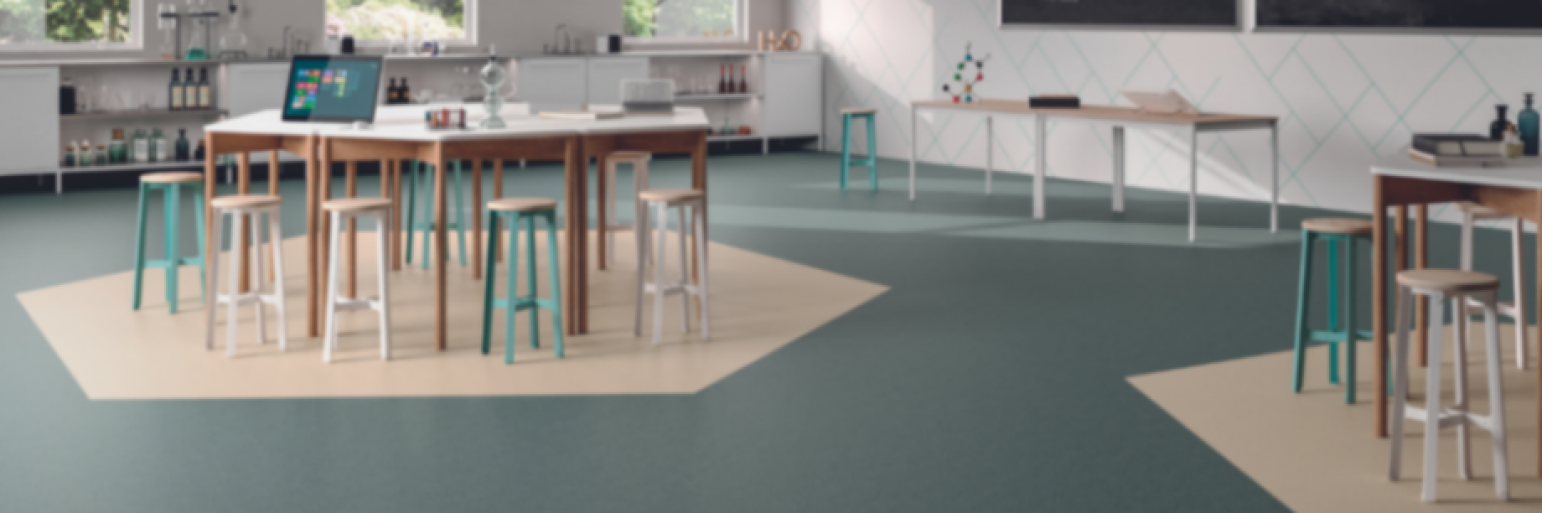
Conductive Homogeneous PVC gains conductive properties through carbon particles added during production. It is preferred in areas like laboratories where antistatic values are insufficient and full conductivity (10⁴ ≤ R ≤ 10⁶ Ω) is required.
Heterogeneous Roll PVC primarily consists of two layers: a top layer and a base layer. Its pattern is achieved using a film layer between these layers, offering a wide variety of designs, including wood, stone, ceramic, and concrete looks. In heterogeneous PVC, the wear layer on the top, which handles heavy traffic, is critical for the material’s quality. Commercial-grade heterogeneous PVC requires a minimum wear layer of 0.50/0.55 mm, with 0.70 mm being commonly used. Hygiene and protective technologies applied to the wear layer facilitate maintenance and extend the product’s lifespan. Its multi-layer structure allows for additional functional enhancements.
Acoustic PVC flooring options are also available as an alternative, reducing heel impact noise and increasing walking comfort.
Sports PVC flooring alternatives are designed for performance criteria in sports halls, basketball, and volleyball courts.
Slip resistance is an essential factor in flooring. Heterogeneous PVC with a specially engineered top layer provides enhanced slip resistance, expressed with R values. Grades R9 to R12 are selected based on the space’s functional requirements and are often used in educational cafeterias and wet areas.
With its advantages and ongoing technological developments, roll PVC flooring is a preferred choice for many long-lasting buildings. Its ease of design and application allows it to serve as a decorative element while providing hygienic, durable, and high-traffic solutions for educational institutions.
Key features of commercial-grade PVC flooring include:
-
Antibacterial and antistatic properties
-
Hygienic and easy-to-clean surface
-
Long-lasting and cost-effective
-
Noise absorption compared to hard flooring and advanced acoustic features
-
Liquid resistance
-
High heat tolerance
-
Health-safe materials
Installation of roll PVC flooring is straightforward but requires proper substrate preparation. To fully benefit from the flooring’s performance, the surface must be strong and smooth. Subfloor assessment should be performed first, and if necessary, leveling screed should be applied before installing the roll material. Correctly prepared surfaces and properly welded seams are crucial for the wear layer’s durability.
Unigen combines its extensive experience in the flooring sector with a wide range of products and professional project/application teams, serving numerous educational institutions domestically and internationally.
Some examples of commercial-grade roll PVC flooring projects include:
-
Medeniyet University Library (16,209 m²)
-
Hacettepe University Conservatory (15,000 m²)
-
Astana University (9,500 m²)
-
Gelişim University (3,500 m²)
-
Ege University (3,280 m²)
-
Near East University (1,600 m²)
-
Gedik University (3,000 m²)
-
Bahçeşehir Colleges – 30 cities total (600,000 m²)
-
Büyükçekmece Bil School (6,680 m²)
-
Antalya Konyaaltı İstek Schools (3,171 m²)
-
Liv College Çekmeköy (7,006 m²)
-
İstek Schools (2,450 m²)
For detailed references, please contact us.
Discover